Showing posts with label Unneccessarily Confessional. Show all posts

Monday, March 17, 2008

I Am My Mother's Son

I wrote a long time ago about how I started quilting. Summary: In 1994 I was sick, I stayed with my parents for a few months, I got fascinated watching Mom quilt, and one thing led to another.

I've been wondering lately how much I've been influenced by the specific piece that Mom happened to be working on that summer. Here it is:


Now, to be clear: I would never make this specific piece in a million years. I don't know if I could, for one thing -- when my mother does something, she tends to do it right -- but also, it's a bit, well, girly, isn't it. Hearts aren't really my thing. There, I said it.

Nevertheless, I think this quilt had a really profound effect on me. Let's start with its method of construction, in which a pattern is formed from a grid mosaic of 2-inch squares (1 1/2" finished, for those of you taking notes). The first eight quilts I made were all composed with 2-inch squares; Cow Quilt, my fourth quilt [shown at right], had a few larger blocks interspersed, but the basic idea was still the 2" grid. My ninth and tenth quilts mixed things up by using different sized squares, but they were still basically grids. It wasn't until the eleventh quilt I made that I finally tore myself away and used something other than squares. It's as if the grid was what quilting was for me, because the one time I had watched somebody else quilt, that's what she was using. Any deviation from that, I had to make up on my own.

Another thing: Mom, and me, were both very impressed and influenced by the Deidre Amsden's "Colourwash" books (my first quilting memory is getting Mom an Amsden book off of her Christmas wish list and thinking, "Woah, this is awesome!"), but if you are familiar with that genre you'll notice that Mom's heart doesn't look at all like the conventional colourwash or watercolor quilt. Mom was a lot more interested in using fields of color, and that gives her piece a lot of its power.

Well, maybe it's just that I, too, am drawn to fields of color. Or maybe it's the influence of that heart quilt. Whichever, I can watch myself experiment with my own far less subtle fields of color all the way from my very first quilt:
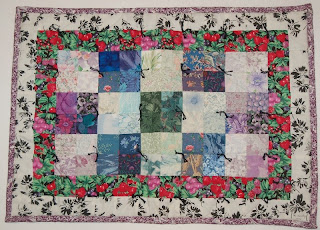
...through, say, my 10th quilt, a Scrabble board:


...or my 20th quilt, the unlovely Green, Blue, Purple, the name of which gives away what I was experimenting with:
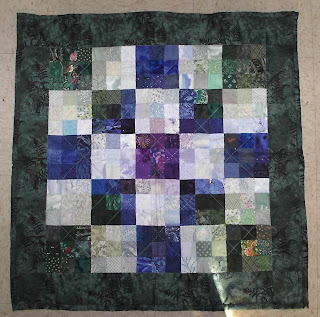

Or even this wedding quilt I made for my friends Mary Beth and Kim in 2002:

Looking through my photos, it seems like at least a good half of my quilts are still working out the implications of that first quilt I watched my Mom make, trying to create a pattern using fabric value, in the colourwash tradition, but with a fairly blunt use of pure color.

Both of these qualities, by the way -- the 2-inch grid and the colourwash-with-fields-of-color -- are running riot in the last major piece I've finished, Labyrinth, or in the Quilt Map of Oregon I showed in the last post.

---

All of this makes me wondered what would have happened if Mom had been working on some other project when I happened to be sick. If she had been working on one of her more classic colourwash quilts, how different would my own ideas about design be today?
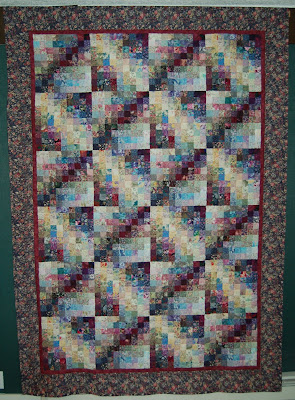


Or what if she had been working on this one? I might not have ever become a quilter; I admire this all-green piece on a technical level, but I can't imagine that it would have fired up my enthusiasm for color and mosaic. If it had somehow got me quilting, I'm pretty sure that the work I'm doing today would look quite a bit different than it does.
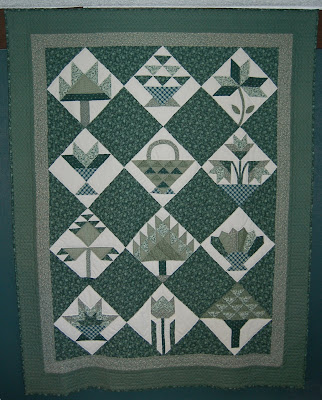

Or here's a scary thought -- what if I had found a really good book, and hadn't gone in to watch Mom work on her quilt at all? It would have been a whole different life, I'll tell you what.

It would certainly be a whole different blog.

Wednesday, October 24, 2007

My Machine

So this is a sentimental story about a man and his sewing machine.

It's an old machine, a 1973 Kenmore, back when they made 'em out of metal and therefore fairly indestructable. It isn't great, and it certainly isn't fancy, but I wouldn't be surprised if I'm able to use it for the rest of my life.


I was in graduate school when I learned to quilt, so there was really no possibility of buying something as extravagant as a sewing machine. I planned on, for the foreseeable future, doing my designing and cutting at home, then pieceing everything together as quickly as possible on my mom's machine at Christmas and Summer breaks.

While this was happening, my older brother was buying his house in Ashland, Oregon. It was one of those "as is" home sales, meaning that he also ended up buying lots of miscellaneous crap stored in the basement. Amongst that crap was the old Kenmore.

"What should I do with this sewing machine?" he asked my mom.

"You know, your brother would really love that as a Christmas present," she told him.

"Really?" he asked.

And that's how I got my sewing machine. He gave my sister a circular saw. It was the best Christmas ever.


Why I Love My Sewing Machine

1. It's old enough to be cool. Keepin' it real!

2. It does everything a sewing machine needs to do: it makes a straight stitch, on very rare occasions a zig-zag stitch, and a couple times a decade a buttonhole. All you need.

3. It took a while, but I found a walking foot for it. (That's a gizmo that grabs the fabric from both top and bottom, instead of just the bottom, to feed fabric under the needle.)

4. Also, although I can't "lower the feed dogs" (never mind), I can still do free motion quilting with a "darning plate." I like having a "darning plate". How many guys do YOU know who have a "darning plate"?

5. That metal indestructibility thing is O.K.!

6. And, not to get all after-school special on you, but hey! My brother gave it to me!


Why I Will Get Another One Next Year

Next fall, I will send the last student loan check into the black hole. Then, by way of celebration, I'm gonna get me a new machine. Here's why.

1. The actual sewing surface on the Kenmore is only about three inches by eight inches, which is waaaaay too small for quilting.

(although things got much, much better when I got a custom "Clutter Gutter," which is an awesome supplemental sewing surface made for exactly this purpose by a woman here in Portland. I can't recommend it highly enough.)


2. It doesn't have a very wide "throat." The opening on the right side of the needle is average at best. When you are working on a full-size quilt, you have to ram a lot of twisted up fabric and batting through that space, so you don't want it to be small. A big throat is the main thing I'll be looking for in a new machine.

3. A few modern gizmos are cool. Getting the top and bottom threads at the same level of tension is a technicality that's important, and a real pain in the butt on an older machine. On lots of new machines, that's super easy. Also, you can set most of them so they always stop with the needle down. That's important, because it gives you more control when you're stitching around a corner.

4. The old machine is, well, old. It needs to be repaired every few years.

5. It's a HUGE pain to oil. Really. It takes, like, a half hour.

6. If I had two machines, I could host a little craft night sort of dealie. Or maybe take a student. That sort of thing.


Audience Participation Time

So that's the story with my machine. What's YOUR machine like?


[Last Year in SotC: I was working on my machine quilting skills, and my practice pieces were looking pretty cool. I'm not doing anything very intricate right now. But, I'm actually machine quilting real quilts, instead of just practicing, so that's a big improvement.]

Monday, January 30, 2006

The Whole Quilting/Mental Health Thing, Vol. II

The Whole Quilting/Mental Health Thing, Vol. II
DATE: 01/30/2006 10:25:09 PM
-----

From the original "Friendster" version of State of the Craft.

So. When we left off, it was 1994, I was recovering from a nervous breakdown in sunny Bandon-by-the-Sea, Oregon, I had become fascinated with my mom's quilting, and I had made my little placemat-sized first quilt.

What I haven't really articulated, neither here nor to myself, is WHY I became fascinated and then started into quilting. I've always loved color and pattern, which I supposed goes a long way towards explaining it. Never especially good with paint or pencil, I found fabric a very forgiving and manageable medium. Too, quilting is well suited for abstract patterns, so one doesn't have to fret over subject matter -- and when it comes to subject matter, I've always had a pretty wooden imagination.

Anyway, let's get this narrative show back on the road. I finished that little placemat, and Mom left town for a short trip, naturally assuming that I had made my one quilt, that it was kind of cool but not something likely to be repeated.

By the time she got back, after a long weekend, I was well into putting together my second quilt.

Now, "Number Two," as I think we can fairly call it, is a piece that makes a strong case that a beginning designer needs the guiding hand of a mentor. It is telling that, to put a picture of it here, I had to find it and photograph it tonight -- until now, it had gone 12 years without anyone ever thinking to take a picture of it. It is not handsome. It is not interesting. It is not at all clear what I was thinking.

In its defense, it did look slightly better before the black fabrics faded unevenly, as black fabrics tend to do. The craftsmanship is not terrible for an unsupervised second effort, and if I hadn't used the reds.... but then, I did use the reds.

Before I left Bandon, under my own power, I was to make two more quilts, including the Cow Quilt. The Cow Quilt is always the one people like best, which can be a bit of a drag -- I made it 40 quilts and 12 years ago, damn it! One likes to think one is making progress! Doesn't one? Not always trying to catch up with the third piece he ever made?

Well, hell, it's nice to have made something people like. It has hung in a quilt show in Bandon, in the Bandon Public Library, and in the "Foyer Gallery" at IRCO, which is all very flattering. It currently lives in the guest room.

So. It's one of those unanswerable questions, the extent to which taking on quilting helped me recover from my first big mental health crisis, or if it was just something that incidentally happened while I happened to be recovering. My therapist says that creative processing, and even the arm motions characteristic of, say, working on a quilt (or playing a musical instrument) makes your brain fire off good chemicals. And it's definitely true, I've learned over and over, that working on something that absorbs you can keep your mind from gnawing on itself, at least on a good day.

I took a class several years ago, although it seems strange to say so now, in which the final project was to do a self-revalatory performance art piece. No, really, I did. And I told the story about how I learned to quilt, exploiting the metaphoric possibilities to the hilt. I even used the phrase "stitching the pieces of my life back together." And there have been times when I actually believed it -- really believed that quilting saved my life, by giving me a focus, or a competance, or a meditation, or something that I could just immerse myself in until the world around me righted itself again.

Other times, it just seems like a hobby.

PROGRESS REPORT: The challenge quilt is coming along beautifully. The face is pretty much completely laid out, and I have been pouring my weekends into the details of the piecing. I think I will make the deadline. I can not wait to show it to you, Gentle Reader. Even more, I can not wait to work on something else, or even clean the house for crying out loud. Alternating between work and this project (and, it must be admitted, "Civ IV") begins to feel like life without weekends. And that's no good.


P.S. If you are wondering about the performance art piece, it was a hit. Predictably, I wowed 'em when I unfurled my quilts. What really floored them, though, was when I threaded the sewing machine. You could have heard a pin drop. I guess people aren't used to seeing guys do that.

-----
COMMENT:
AUTHOR: mia
DATE: 02/01/2006 08:12:39 PM
whatever makes you happy and sane, you are blessed to have at lease one thing that people say wow at. many people don't have the skills to show off like you do with your quilts. i truly admire your passion, talents, and patience for one thing. can't wait to see your finished project.....
-----

Tuesday, January 24, 2006

The Whole Quilting/Mental Health Thing, Vol. I

----
The Whole Quilting/Mental Health Thing, Vol. I
DATE: 01/24/2006 09:41:46 PM
-----

From the original "Friendster" version of State of the Craft.

Alright, it's time to talk about the quilting/mental health connection, so listen up. Or, if you're uncomfortable with this kind of thing, skip the entry. No worries.

OK, still with me? Alright, if you are reading this, you probably already know that I have encounters with Clinical Depression every few years. Well, that's how I came to quilt.

My first definite episode of Depression began in the summer of 1994. I was stuck in Kansas, had no schedule to keep me focused, and didn't have a clue what was happening, and things quickly spriraled out of control. Within less than two months, I developed symptoms of anorexia (losing 35 pounds off of what was already, at the time, a fairly slim frame) and a full-blown case of agoraphobia that was to stick with me for the next five years. At that point, as a happier alternative to offing myself, I flew back to Oregon to, basically, put myself back in the care of my parents for a while.

To make a long story short, it all worked out. I started eating again, we got my meds sorted out, and if I still had trouble going more than 25 miles or so, at least I was OK leaving the house. In the meantime, I was spending a lot of time around my parents, helping Dad with yardwork and whatnot and -- here's the tie-in -- watching my Mom work on a quilt. The yardwork was nice, but I found the quilting completely fascinating.

The quilt Mom was working on was like the ones I talked about last week in the sense that it was a single image composed of hundreds of small "two-inch squares." A two-inch square is, duh, a little piece of fabric that is two inches by two inches. This can get confusing, though, because a quarter inch on each side of the piece disappears when it gets sewn to its neighboring pieces. That quarter inch is called the "seam allowance," and because of the seam allowance, a two-inch square only measures 1 1/2 inches by 1 1/2 inches in the actual quilt.

Like Robert Silvers (or better, David Hockney) creating a photomosaic... Like Seurat painting Sunday Afternoon on the Island of la Grande Jatte (well, kinda).... Mom would place these little squares together so that they were each interesting in their own right, blended with their immediate neighbors in interesting ways, and added up to an overall composite image. I probably wouldn't have chosen a big heart as the overall image, but then I wasn't doing the work. The completed quilt is pretty stunning even if you aren't much into big hearts, and it won several judges' and audience choice awards in local shows.

But I digress. The point is, Mom had hundreds of these two-inch squares sorted in little stacks, like -- pick your metaphor -- paint on a palette, or like pieces of a jigsaw puzzle. And it was just really, really interesting to watch her -- stick with your chosen metaphor, please -- use them to paint the image on the felt canvas she was using to lay out the quilt, or try to assemble the puzzle with jigsaw pieces that hadn't been made to go together. Like any jerk watching a solitare game, I began to make "helpful suggestions." Most were not helpful, of course, but it was always interesting to hear back why they weren't. The number of variables that determined whether a given square belonged where it did was pretty amazing.

In a thinly-veiled attempt to get me out of her face, Mom cut me a piece of felt, gave me a stack of reject squares, and suggested that I try a little layout. Who could resist? ...well, I suppose lots of people could resist, but I was hooked, and had nothing but time on my hands, and nothing to lose. So, I made this little placemat-sized design, with greens, blues, and purples arranged in a checkerboard pattern of color value. When I announced that I wanted to put it together, Mom looked pained -- later, I realized that she expected that she would have to put it together for me. But no: I wanted to learn the whole process.

For the life of me, I can't remember WHY I wanted to learn the whole process. It may be that, having recently spent two years completing a master's thesis, I was desparate to create something of actual value. Or, if that's too cynical, maybe I wanted to see something good (or, at least, purty) come out of what was otherwise turning out to be a real washout of a summer. Whatever. I learned the basics of running a sewing machine, and pieced that puppy together. I learned how to "tie" -- a cruder, faster method than actual quilting of putting the three layers of your piece together. And voila! I had made a quilt!

to be continued
-----