Alright, this here is the first State of the Craft entry for the 2006-2007 Quiltin' year, and the the first entry on our new host, Blogger. Thank you, gentle reader, for seeking out the new site. Please note that, on Blogger, anyone can comment. Click on "comment" at the bottom of a post, pick "other" where it says "choose your identity," and you'll be good to go.
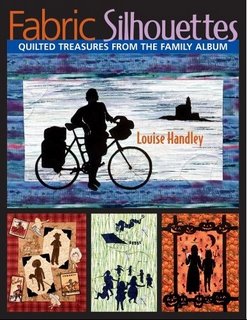
But, before we begin, a brief commercial message. No, really! I am happy and very proud to announce (or, for many of you, re- or re-re-announce) that my mother's first book, Fabric Sihouettes: Quilted Treasures from the Family Album, is now available for pre-order on Amazon (
HERE is a link).
I'll have more to say about this book in future entries, but for now I'll just encourage everyone to order, at a minimum, copies for themselves and for everyone in their address book.
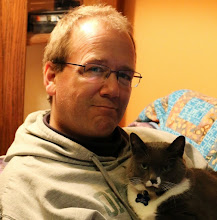
Frequently Asked Question: "Is that you on the bike?"
A: Yes, it is. I am also, for my sins, the one on the stickhorse in "My Little Cowboys," the quilt on the lower left of the cover. Lamentably, the book includes the humiliating original photograph from which that silouette was taken. The deep psychological scarring associated with having this and other "treasures from the family album" made public will no doubt be a recurring theme in future entries to this blog.
---
MULTIGENERATIONAL MADNESS
Although quilting has gained some recognition as a contemporary art form in the last 15 years or so, it still has very strong down-home, ol'-fashioned associations in the minds of most. And this makes sense -- modern quilting, for all of its rapidly expanding notions of what is possible in the medium, is still deeply rooted in the quilting traditions of the 19th and early 20th centuries. Indeed, there are still active quilters (my Mom, for instance) who learned quilting at the end of that earlier tradition; many (but not Mom, to my knowledge) quilted continuously, even through the 1950s and 1960s, the decades when traditional quilting was essentially dead and the modern revival had not yet started.
Of course, other art forms -- painting or sculpture or photography, say -- are deeply rooted in their histories, but don't seem like old-fashioned things to do. This might have to do with the
practical roots of quilting. Making one's own blanket, like churning one's own butter or thatching one's own roof, is definitely something that is not necessarily a part of modern life. And, as a medium of expression, a blanket has an aura of outrageous wholesomeness that the canvas, clay, and photographic plate really can't compete with.
That wholesomeness is old-fashioned goes, I trust, without saying.
There is a whole branch of quilters who are only really interested in "vintage" or "period" quilts. Indeed, most serious quilt collectors are
only interested in 19th and early 20th century pieces. Some quilt shows have a category for reconstructed quilts -- vintage quilts in which a quilter has repaired damage, or an incomplete vintage piece that a modern quilter has finished. While I've never been especially interested in vintage quilts, myself, I've always thought the reconstructed quilt concept was cool in that it brings traditional and modern quilting together quite literally in a given piece.
I never expected to get involved in quilt reconstruction. But....
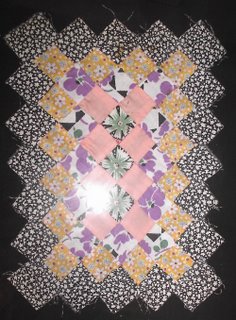
In the early 1930s, Mary Sampson, the grandmother of my grandmother's cousin, had such severe arthritis that she could no longer comfortably hold the weight of a full quilt top. An lifelong quilter, now in her late 80s, she continued to make individual blocks. Lots of individual blocks. Made of one-inch squares, following a kind of "Around the World" pattern, and sewn by hand with needle and thread with tremendous craftsmanship, these little quilts are works of art in themselves (we have some mounted behind glass hanging in our living room). They are also testament to the time on one woman's arthritic hands -- by the time of her death in 1934, there were hundreds upon hundreds of these blocks. All of a pattern, and unified by the black and white fabric of their outer rings, they appear to have been intended for a single project. Sampson, however, had made three or four times as many blocks as would have been needed for even the largest imaginable quilt.
Following Sampson's death, the blocks were placed in shoeboxes and shuffled from family member to family member over the following decades until they ended up in my grandmother's hands. Grandma, more a knitter than a quilter, gave them to my mom, who felt guilty about them for several years before giving them back to Grandma -- Mom isn't even
related to Mary Sampson, except through my Dad. After Grandma died in the late 1980s, however, the blocks ended up decisively back in Mom's lap.
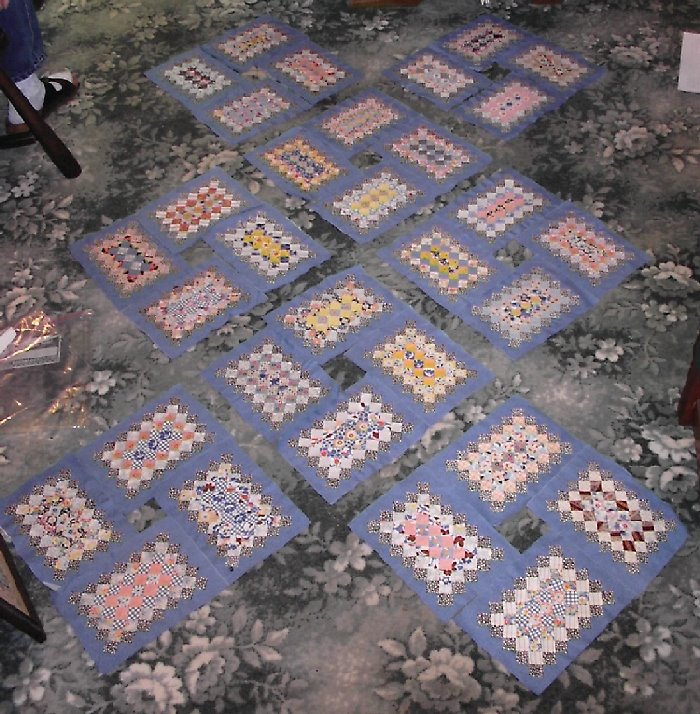
Mom set out concientiously to deal with this combination treasure trove/guilt trip. Over the coming years, she would make two quilts from the blocks, as well as a third from other pieces left by Sampson. She gave sets to each of my sisters, who have worked with them over the years. This still left one final set of 32 blocks. She put this last set on backing material in 1994, but got no further with it.
Now, even before she decided to write a book, Mom was plenty busy. Moreover, she hand-quilts everything she makes, which means that her projects take months and months to finish. As a result, she has literally dozens of projects in the pipeline at any given time. And lately, she's been thinking a lot of how to lighten some of that load.
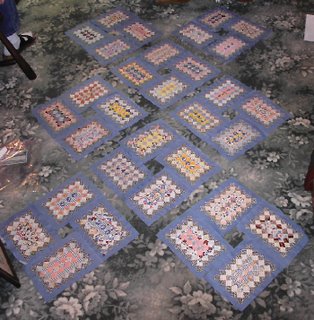
Last week, she got one long-stalled project off of her plate by presenting me with the final set of 32 Mary Sampson blocks. Well, maybe "presenting" is a little too grand -- she actually dropped them in my lap, quite literally, and informed me I would be responsible for them henceforth.
I'm more than happy to do it, though. I don't know much about this kinda-sorta ancestor of mine, but even so, working with these blocks has already (I immediately started experimenting with design, with the pattern shown here being a lead contender so far) made me feel connected to the history and tradition of the craft. Plus, I know Mom wouldn't be setting me loose with these blocks if she didn't feel I was at least marginally competant, and that's huge -- I've arrived! I've arrived!
Now, hopefully I won't screw up. I'll let you know how it goes.
Peace.


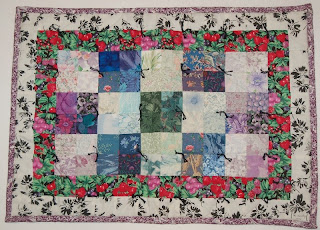

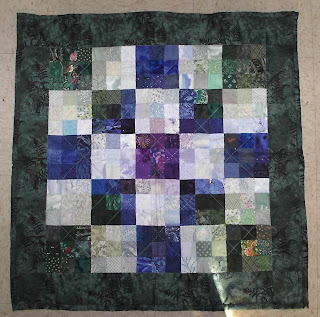
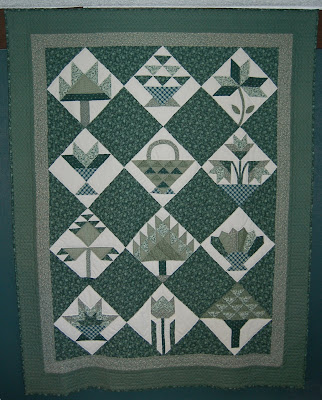
 Looking through my photos, it seems like at least a good half of my quilts are still working out the implications of that first quilt I watched my Mom make, trying to create a pattern using fabric value, in the colourwash tradition, but with a fairly blunt use of pure color.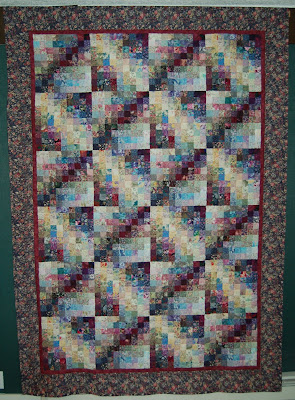


 In the early 1930s, Mary Sampson, the grandmother of my grandmother's cousin, had such severe arthritis that she could no longer comfortably hold the weight of a full quilt top. An lifelong quilter, now in her late 80s, she continued to make individual blocks. Lots of individual blocks. Made of one-inch squares, following a kind of "Around the World" pattern, and sewn by hand with needle and thread with tremendous craftsmanship, these little quilts are works of art in themselves (we have some mounted behind glass hanging in our living room). They are also testament to the time on one woman's arthritic hands -- by the time of her death in 1934, there were hundreds upon hundreds of these blocks. All of a pattern, and unified by the black and white fabric of their outer rings, they appear to have been intended for a single project. Sampson, however, had made three or four times as many blocks as would have been needed for even the largest imaginable quilt.