Sunday, July 23, 2006

Quantifying Aesthetics


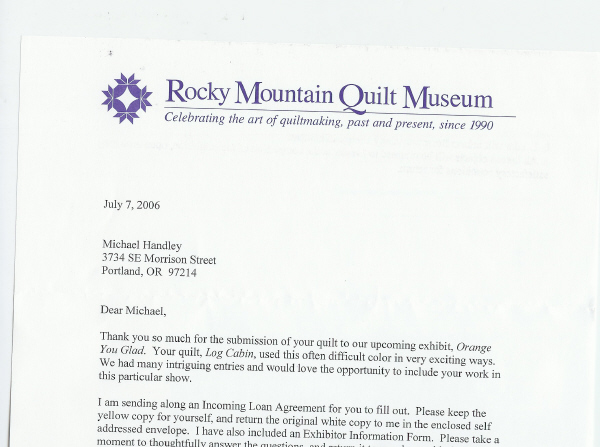
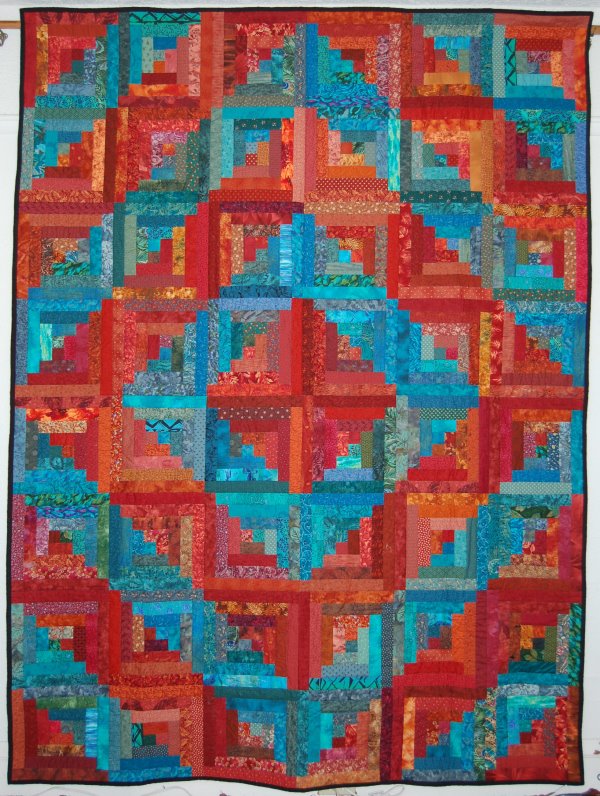
First of all, some elaboration on the last post. As the letter says, the Rocky Mountain Quilt Museum, in Golden, Colorado, has accepted Log Cabin, which is the one I had in the guild show a few months ago, for an exhibit. It will be shown from August 15 to October 21. This is a coup, probably more of a coup than the quilt really deserves, but I am completely stoked about it nonetheless.

I hadn't really expected it to be accepted. The RMQM has a show of quilts by men every two years, and that was my real target. I thought that if I submitted a piece now, they would know my name when the men's show came around. As it is, I wonder if the esoteric category of the show I was accepted for -- quilts using the color orange -- might have made it a "soft" field of entries.

So, I stuck Log Cabin in a box and mailed it to Colorado on Thursday. Even now, I'm afraid they'll say "sorry, dude, it looked better in the photo than in real life, we're not going to show it." But I hope not. My in-laws live in Colorado, and being shown in an honest-to-God museum has won major points with them, or at least helped to legitimize the whole boy-quilter thing.

Anyway, its good that Log Cabin is doing well, because it turns out that it is the perfect embodyment of the Michael Handley aesthetic. And I can prove it.

A couple weekends ago, I drove down to Sisters, Oregon, for their annual outdoor quilt show. The largest outdoor quilt show in the world, we're told, and it's not hard to believe -- pretty much every exterior surface of that oh-so-faux little village gets covered with quilts for one hopefully dry day every year, and the town turns into a packed madhouse of, well, the kinds of people who get excited about quilts. Such as myself.

There is no particular organizing principle to the layout of the quilts that I could detect, and with 1500 or so quilts to see and no one to talk about them with, I was initially a little puzzled on how to proceed. After fifteen minutes or so of checking out the scene, though, it occured to me that I had the opportunity to conduct an unusual experiment on myself. I could use the show to explore my own tastes, and find out if there are any specific kinds of quilts that I particularly respond to.

I used a highly sophisticated methodology for this experiment: I took pictures of quilts I liked. Which is to say, I walked around the town, taking a brief glance at nearly all of the pieces on display, and without further thinking took pictures of the ones I was immediately attracted to. I tried to surpress any thinking about craftsmanship, tradition, innovation, symbolism, or anything else beyond an immediate gut reaction. I didn't note who the quiltmaker was, and I didn't make any attempt to get a good picture -- just a quick snapshot of every quilt that jumped out at me.

I ended up taking 75 pictures, meaning -- if we stipulate that the Sisters show represented a reasonable cross section of quilting as a whole -- that about 5% of quilts jump out at me. Through the miracle of modern uploading, I have placed the entire collection online at http://pg.photos.yahoo.com/ph/drhandley/my_photos, where you are welcome to take a look if you so desire.

So, is there some kind of pattern to the quilts I like? Oh mai oui. Embarassingly so, as it turns out.

Of the 75 quilts I liked, it turns out that 68 of them are geometric -- i.e. composed of rectangles, triangles, circles, diamonds, and occasionally hexagons or octogons. (19 of them, in fact, are composed only of squares and rectangles).

Now, this is interesting to me, because most of my own pieces are also geometric. I have always had the nagging fear that I worked in geometries because it is easier than the piecing or applique techniques involved in working with non-geometric shapes (although that isn't necessarily true), or because I am too lazy to learn new techniques. But, having done this experiment, I'm thinking I might stick with geometries for the more defensible reason that those the kinds of quilts I like. It doesn't seem like it should be a startling revelation, but it kind of is.

A whopping 62 of the 75 are not only geometric, but also symetrical, laterally or vertically, or both. (I designated five more are "semi-symetrical," whatever that means.) I guess I like orderliness in my geometrical patterns.

How about color? Well, it would seem I like vivid, saturated colors -- 43 of the quilts I liked use brilliant "jewel tones" in their coposition. And another 43 -- quite a bit of overlap here, obviously -- used patterns based primarily on contrasting color values. Here, again, what I like seems awfully similar to what I do. More than half of my quilts are patterned on value contrasts, and yeah, I'm a notorious jewel-tone junky.

Log Cabin is made exclusively of rectangles -- 768 of 'em -- so it's nothing if not geometrical. It's laid out in a tightly symetrical pattern. In earlier posts, we've talked about it's refusal to involve a value contrast, but it certainly cranks up the brilliant saturated colors. According to my experiment, it is exactly the kind of quilt I like. So, it seems appropriate that it is my flagship piece for the moment.

It's nice to know what I like. Now I can go make more.

Wednesday, July 12, 2006

My Favorite Letter Ever


....well, one of my favorites anyway.

If it's too small to read, you can click on it, or any other image, to show them full-size.

Sunday, July 09, 2006

Multigenerational Madness

Alright, this here is the first State of the Craft entry for the 2006-2007 Quiltin' year, and the the first entry on our new host, Blogger. Thank you, gentle reader, for seeking out the new site. Please note that, on Blogger, anyone can comment. Click on "comment" at the bottom of a post, pick "other" where it says "choose your identity," and you'll be good to go.

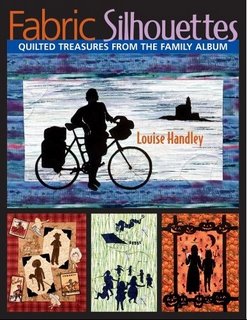
But, before we begin, a brief commercial message. No, really! I am happy and very proud to announce (or, for many of you, re- or re-re-announce) that my mother's first book, Fabric Sihouettes: Quilted Treasures from the Family Album, is now available for pre-order on Amazon (HERE is a link).

I'll have more to say about this book in future entries, but for now I'll just encourage everyone to order, at a minimum, copies for themselves and for everyone in their address book.

Frequently Asked Question: "Is that you on the bike?"

A: Yes, it is. I am also, for my sins, the one on the stickhorse in "My Little Cowboys," the quilt on the lower left of the cover. Lamentably, the book includes the humiliating original photograph from which that silouette was taken. The deep psychological scarring associated with having this and other "treasures from the family album" made public will no doubt be a recurring theme in future entries to this blog.

---

MULTIGENERATIONAL MADNESS

Although quilting has gained some recognition as a contemporary art form in the last 15 years or so, it still has very strong down-home, ol'-fashioned associations in the minds of most. And this makes sense -- modern quilting, for all of its rapidly expanding notions of what is possible in the medium, is still deeply rooted in the quilting traditions of the 19th and early 20th centuries. Indeed, there are still active quilters (my Mom, for instance) who learned quilting at the end of that earlier tradition; many (but not Mom, to my knowledge) quilted continuously, even through the 1950s and 1960s, the decades when traditional quilting was essentially dead and the modern revival had not yet started.

Of course, other art forms -- painting or sculpture or photography, say -- are deeply rooted in their histories, but don't seem like old-fashioned things to do. This might have to do with the practical roots of quilting. Making one's own blanket, like churning one's own butter or thatching one's own roof, is definitely something that is not necessarily a part of modern life. And, as a medium of expression, a blanket has an aura of outrageous wholesomeness that the canvas, clay, and photographic plate really can't compete with.

That wholesomeness is old-fashioned goes, I trust, without saying.

There is a whole branch of quilters who are only really interested in "vintage" or "period" quilts. Indeed, most serious quilt collectors are only interested in 19th and early 20th century pieces. Some quilt shows have a category for reconstructed quilts -- vintage quilts in which a quilter has repaired damage, or an incomplete vintage piece that a modern quilter has finished. While I've never been especially interested in vintage quilts, myself, I've always thought the reconstructed quilt concept was cool in that it brings traditional and modern quilting together quite literally in a given piece.

I never expected to get involved in quilt reconstruction. But....

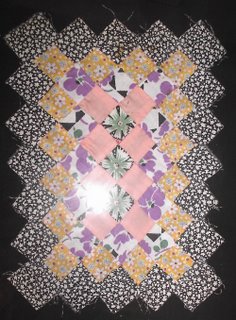
In the early 1930s, Mary Sampson, the grandmother of my grandmother's cousin, had such severe arthritis that she could no longer comfortably hold the weight of a full quilt top. An lifelong quilter, now in her late 80s, she continued to make individual blocks. Lots of individual blocks. Made of one-inch squares, following a kind of "Around the World" pattern, and sewn by hand with needle and thread with tremendous craftsmanship, these little quilts are works of art in themselves (we have some mounted behind glass hanging in our living room). They are also testament to the time on one woman's arthritic hands -- by the time of her death in 1934, there were hundreds upon hundreds of these blocks. All of a pattern, and unified by the black and white fabric of their outer rings, they appear to have been intended for a single project. Sampson, however, had made three or four times as many blocks as would have been needed for even the largest imaginable quilt.
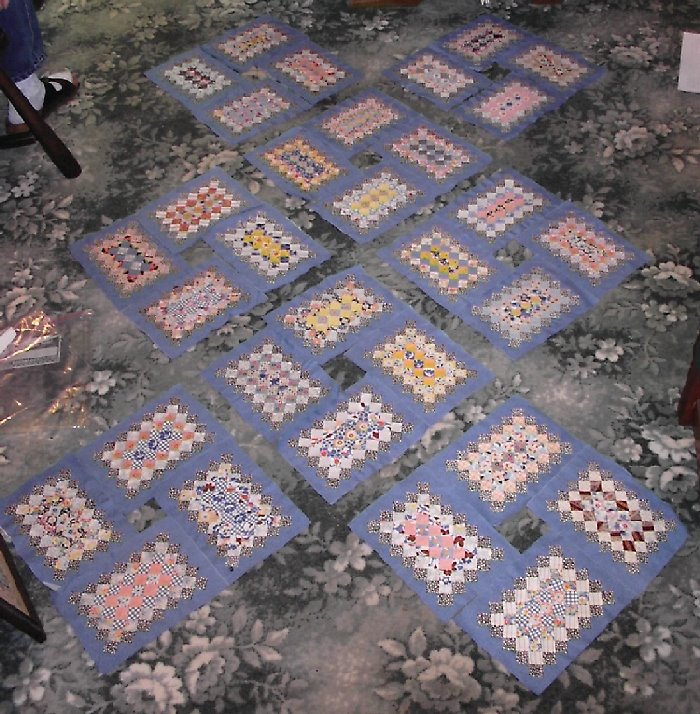
Following Sampson's death, the blocks were placed in shoeboxes and shuffled from family member to family member over the following decades until they ended up in my grandmother's hands. Grandma, more a knitter than a quilter, gave them to my mom, who felt guilty about them for several years before giving them back to Grandma -- Mom isn't even related to Mary Sampson, except through my Dad. After Grandma died in the late 1980s, however, the blocks ended up decisively back in Mom's lap.

Mom set out concientiously to deal with this combination treasure trove/guilt trip. Over the coming years, she would make two quilts from the blocks, as well as a third from other pieces left by Sampson. She gave sets to each of my sisters, who have worked with them over the years. This still left one final set of 32 blocks. She put this last set on backing material in 1994, but got no further with it.

Now, even before she decided to write a book, Mom was plenty busy. Moreover, she hand-quilts everything she makes, which means that her projects take months and months to finish. As a result, she has literally dozens of projects in the pipeline at any given time. And lately, she's been thinking a lot of how to lighten some of that load.

Last week, she got one long-stalled project off of her plate by presenting me with the final set of 32 Mary Sampson blocks. Well, maybe "presenting" is a little too grand -- she actually dropped them in my lap, quite literally, and informed me I would be responsible for them henceforth.

I'm more than happy to do it, though. I don't know much about this kinda-sorta ancestor of mine, but even so, working with these blocks has already (I immediately started experimenting with design, with the pattern shown here being a lead contender so far) made me feel connected to the history and tradition of the craft. Plus, I know Mom wouldn't be setting me loose with these blocks if she didn't feel I was at least marginally competant, and that's huge -- I've arrived! I've arrived!

Now, hopefully I won't screw up. I'll let you know how it goes.

Peace.

Wednesday, May 31, 2006

Turn, Turn, Turn

From the original "Friendster" version of SOTC.

--------Turn, turn, turn.DATE: 05/31/2006 11:08:20 PM-----

Helloooooo, Quilt Fans!

Thought I'd pitched it in, didn't you? Thought this was just one more 3-month flash-in-the-pan blog, glorious in its brief prime but doomed to inevitable burnout and failure?

No way. Not "State of the Craft."

But to everything, turn, turn, there is a season, turn, turn, etc., and for many of us quilting is pretty seasonal as well. Other things get pretty distracting in spring and summer, like travel, hiking, outdoor activities, and, unless you are Charlie or Eric, the garden. Also, not everyone wants to have five pounds of thick, insulating blanket on their lap during high summer. So the quilting slows down, and naturally the quilt blogging slows down as well.

For me, the quilting year generally begins at the kickoff of the first Oregon Ducks football game, which this year will be Saturday, September 2 (at home vs. Stanford -- a cakewalk). Then, or maybe a little before, the quiltin' will commence in great earnest. Until then, though, progress will be piecemeal at best.

One small thing I do want to do over the summer is find a new host for this blog. Two reasons. One is that the noise-making ads that Friendster has been using lately make me, and everyone else I know, want to put fist through screen. Secondly, only my registered Friendsters can make comments (and even they often have trouble with it). Not that you aren't special, Friendsters. You are. You TOTALLY are. But comments are half the fun with a blog, and the rest of the (suprisingly robust) readership needs in too.

I'll let you know.

Anyway, there are two things worth mentioning from the last month and a half. In quilting, that is. In life in general, there was a fabulous road trip, documented at http://pg.photos.yahoo.com/ph/drhandley/my_photos.

The first thing was the Guild Show. Several of y'all came to it, which was TOTALLY GREAT and YOU ROCK. I was very happy with the whole thing. Both of my entries -- the Oregon Map and the Log Cabin, shown in earlier entries -- were hung very nicely, with neighbors that complemented them well. Response from viewers and other members of the guild was very nice. Rather than feeling like I was "OK but way behind the pack," this time I felt like I was "definitely in the pack." It was good.

I volunteered a half day at the show, and when I arrived was given an identifying pink ribbon to wear. "Hostess," it read. The volunteer coordinator seemed surprised by my hesitation to wear this ribbon, but offered no objections as I cut the "ess" off with my jackknife.

The second thing was completeing the wedding present that I obliquely referred to three posts ago. It is one of two mirror-image pieces that are, in terms of design, fragments of a traditional style called "Around the World" that I will talk about in a future post. (This is called "leaving them wanting more.") One of the two goes to our friends Helen and Keir in the UK, who were married last August -- please note that I met the one-year wedding present deadline. The other goes to Sue and I, as a much later wedding present and wall-hanging for our room.

Because of their pattern and because they will be widely-separated twins, I named them "Partway Around the World #1 and #2." I told Helen and Keir that they could decide whether they wanted theirs to be #1 or #2, but I haven't heard back yet.

Well, that's all for now. But we'll talk soon. In September, if not before.

Wednesday, April 19, 2006

The Invisible Man

From the original "Friendster" version of SOTC.

--------The Invisible Man DATE: 04/19/2006 10:51:16 AM-----

I went in to Montavilla Sewing yesterday to pick up my machine; I had had to take it in last week after it started having trouble with erratic tension and skipped stitches. As usual in any sewing or quilting establishment where they don't know me, I had to wait five or six minutes before anyone acknowledged my presence -- it takes them that long to realize that I'm not just a husband in tow. Finally, a perky counterperson asked if I needed help

"I'm here to pick up my machine," I said.

"Oh! Well, can you give me your phone number?" she asked.

"Sure," I said, and gave her the number of my work phone, a number that has about 120 extensions.

She tapped on the computer, looked up at me, and brightly said

"Phyllis?"

Well, no.

---

All right, I'm going to apologize right up front for cribbing my title from Ralph Ellison. Certainly I don't feel discriminated against in any meaningful sense as a man trying to make his lonely way in a woman's world. By and large, I've felt very welcomed to the craft. But still, I am obviously and conspicuously off-demographic, and people's reactions can get kind of comical sometimes.
A few months ago, I went to a new quilt shop near my neighborhood. The woman minding the store gave me a big, friendly welcome when I came in, and then said "You must be here about the leak!"

I wasn't there about the leak, so I said "nope!" I suppose could have been more helpful by saying something like "No, I'm actually a quilter, here to purchase some quilt-related merchandise!" but for whatever reason I hate spelling that out. So, I just said, "nope."
Clearly suspicious, the woman gave me a much less friendly "can I help you with something, then?" Having already spotted what I was looking for, I said, "no, I'm just looking for some chalk."

At this point, she actually moved as if to block me from going any further, and said -- in a disgusted tone, as if I'd said I was looking for some Night Train -- "Chalk?!? This is a quilting store!"

"Yes," I acknowledged. "And you sell quilter's chalk." I helpfully held up a bottle of the stuff (which is used to make non-permanent guide lines when quilting) to show her.

At this point, she made a dizzying 180 from hostile to fawning. For some reason, that bugged me more than the hostility. The hostility had been a fairly understandable reaction to an unexpected presence in her store. The fawning was just annoying, and has so far kept me from going back.

If I go in any new shop with Sue, she will always have to redirect the storekeeper's attention to me. Absolutely always. She's good at it, though.

I've noticed at guild that people are quick to ask me to show them whatever I'm working on, and that some are quick to tell me what I'm doing wrong -- or at least, what they would do differently. But maybe that happens to all new or young members.

It's a fairly common thing that quilters, on meeting me, rush to reassure me that "oh, I know a lot of men who quilt." I've learned not to probe on this point. If I do, they will then tell me about the one man they know who quilts, then look pained.

When I show up at a quilt show, I'm often told that there are "several quilts in this show by men." Well, if that's true, there must be a bunch of male quilters out there named "Sonya," "Margaret," and "Julie."

What they are really trying to do, I suspect, is reassure themselves that I, the person in front of them, is not a freak. My mom, similarly, used to always talk about how "masculine" my quilts were, until I started teasing her about it. "My son's not a freak!! My son's NOT a freak!!" Although I'm not a big fan of embroidered flowers, chintz prints, and ruffles, I have a hard time seeing anything distinctively testosterone-driven in my work, either.

The most odious indignity that a quiltin' man must suffer, though, is exposure to books and articles about Quilts for the Men in Your Life. These are invariably ghastly. Quilts for Men are always thematic, and the themes are as follows: Cars. Sports. Huntin'. Fishin'. Golf. Ties. Yes, friends, that's the sum total of what men are about. Now, in theory, it would be possible to create a golf-themed quilt that was attractive, interesting, or in excellent taste. But I ain't seen it yet.

Sorry this entry doesn't have pictures.

-----

COMMENT:AUTHOR: Charlie DATE: 05/14/2006 06:28:10 PM
Michael man, I hear you. You would not believe the looks I get at my pole dancing classes at Bally's.-----

Tuesday, April 11, 2006

The Challenge Quilt. About Time.

From the original "Friendster" version of SOTC.

-----
The Challenge Quilt. About Time.
DATE: 04/11/2006 10:49:01 PM
-----
All right. At long last, I can show you the challenge quilt. Here it is:
And here's the "artist's statement":
Each square of the Quilt Map of Oregon represents an area of 12 miles by 12 miles. The colors are meant to generally represent types of vegetation, and for their exact distribution I drew heavily on land use maps in the Atlas of Oregon . Quilting represents county boundaries. Most major cities, mountains, and lakes are shown, and are accurately placed within a few miles. Those familiar with the state should be able to pick out the Ochoco, Strawberry, Blue, and Wallowa Mountains, as well as familiar features like the Willamette Valley, Mt. Hood, Crater Lake (and Wizard Island!), and the lower Columbia River.

So, there you have it. The reason it took so long is that I had to find a piece of fabric for each of the 600 squares that represented the terrain, and possibly the cities or mountains, in that section of the state. I actually laid the whole thing out on a poster-sized map of the state -- if you know what to look for, you can see that in the very first picture in this blog.

Last night was the big meeting where the guild voted for the best 8 challenge quilts that will be representin' PDX at the national competition in Nashville. It turned out there were about 20 entries. Mine was probably 19th best, which means I achieved both my goals: I wasn't (too) embarassed to have my piece hanging, and I didn't come in last. After the 8 winners were picked, the rest of us were called up to stand by our pieces, and everybody got a polite round of applause. That was nice. The only moment that could have been a drag was when someone who didn't know I was in the competition pointed mine out to me as one of the ones that "doesn't work." But it didn't bug me. I know it doesn't work.

There are two design problems with Quilt Map. One comes from the dark value of the ocean. I was forced to do a dark ocean by the dark blue of the challenge fabric, but that makes the left edge of the piece much more aggressive than the mild greys that represent Washington, Idaho, Nevada, and Cali. I could have countered this if I'd gone with my initial impulse, and shown the other states in saturated colors like purple, rust, etc. But then, there wouldn't have been enough contrast around the state borders, and it would have been hard to recognize the whole as a map of Oregon. That would have been bad, for a map of Oregon.

The other problem is with the quilting. In the quilt world, dense quilting is valued. And for good reason -- it makes a piece look crisp and gives it texture. Sometimes, the texture of dense quilting is enough, even on an otherwise blank piece of white fabric, to make a stunning quilt in and of itself. Loosely quilted pieces, by contrast, look kind of dull and flabby, and tend to sag.

In Quilt Map, I used quilting to show county lines. That's cool cartographically, but on the west side of the state results in a pretty thin quilting pattern. On the east side of the state, it's a disaster. Malheur County is a big sucker, leaving a gap of five or six inches between quilting lines. Not cool. I entertained the idea of also quilting in rivers and highways, maybe in different colors of thread, but the same problem would come up in the eastern half of the state, where rivers and roads are fairly infrequent. Plus, it would have raised all sorts of tricky decisions about WHICH rivers and roads to include. And I was getting exhausted.

So, it ain't going to Nashville, but it will be at the Quilt show on April 28, 29, 30. (see the post titled "Log Cabin," below). See ya there.
-----
COMMENT:
AUTHOR: Eric
DATE: 04/13/2006 10:35:08 AM
I think it's a really great quilt to be honest with you. Aren't you awarded extra points just for the concept?
-----

COMMENT:
AUTHOR: Michael
DATE: 04/13/2006 06:24:08 PM
To be fair to myself, the judging was done without people seeing the artist's statement. So, they wouldn't have necessarily had a sense right away of how accurate it is, or why it was so thinly quilted. But on the other hand, the eight pieces that are going to the national show were all really spectacular. The people in the guild are wicked good.
-----
COMMENT:
AUTHOR: Charlie
DATE: 04/15/2006 04:47:37 PM
I agree with Eric that you are being too hard on yourself. I think it's really cool. But I did find it interesting that you felt yours to be the 19th best. Was there one that you knew no matter what everyone's was better than, or was it a modest mathematical way of expressing it's not in the top 8 but was not the worst?
-----
COMMENT:
AUTHOR: Michael
DATE: 04/17/2006 03:54:42 PM
Let's make an analogy recording music. We'll stipulate that a few of my songs are really good, as songs -- good lyrics matched to a good melody, harmony, beat, and arrangement. Would you expect to ever hear them on the radio? Of course not. The reason is, I am shaky on the basic skills (singin', playin' guitar) and also on the more subtle skills (miking instruments, equalizing sound, mixing, and all of the stuff I don't even know about that makes a recording sound radio-ready). Other songs, perhaps even a few that arguably aren't as good in their ideal form (if I may get Platonic on your ass (so to speak)) are going to get airplay. Mine aren't.

Thus it is also with quilting, my friends. The overall idea may be good, arguably more interesting than what some of the others came up with, but the details of the execution mean something too. In fact, they mean a lot. I am not embarassing myself by putting quilts like this in the show, but you could make a reasonable case that I'm really a year or two away from "show-ready."

Yes, there was a clear loser, although it was a perfectly respectable entry. (There were also a few that were eliminated for not meeting size requirements, so I guess I "beat" them too). I felt like I was a pretty clear runner-up loser, but a generous observer could have put me in a lower tier with 3 or 4 others.

-----

Sunday, March 26, 2006

Wedding Presents

From the original "Friendster" version of SOTC.

-----
Wedding Presents
DATE: 03/26/2006 11:37:56 PM
-----

I'm sure, gentle reader, that you have been breathlessly anticipating an update on the challenge quilt. Well, I finished it on the Sunday the 12th. On Monday the 13th, I handed it over to a woman from the guild. It was very strange to work on something so intensively for so long, and then to immediately give it to a stranger. But, I guess if I want people to see what I make, I'm going to have to get used to handing pieces over and trusting that they'll come back eventually.

I still can't show you a picture of the challenge quilt, unfortunately. That will have to wait another two weeks, until the Guild meeting on April 10.

With that big project off my plate, I spent a few days going nuts on about four different projects, making bits of incremental progress on all of them instead of focussing on any one piece. It felt good to work on some less fussy quilts, where I could get into a groove and make some fast progress without sweating over every individual stitch.

But eventually, it was time to get serious again. In particular, I've been thinking I really should get started on a wedding present for a good friend who got married, uh, last August. I am a firm believer in the one-year rule, but even at that I've only got four months left on the meter. So, that's what I'm working on now.

Now the problem with this as a blog subject is that once again I'm working on a project that I can't show you a picture of -- since my friends who got married last August might be among you. And I know you, gentle reader. For all of your sophistication and book larnin', you mostly want purty pictures from your quilt blog. It's OK, you can admit it. It's perfectly normal and healthy to want to see pictures of attractive quilts.

So, what I'm going to do is show you some pictures of wedding quilts past. First, though, a note to my friends who were married last August, if you happen to be reading this: what I'm working on for you is not quite to the scale of the pieces I'm describing here. It will be a smaller thing, but hopefully special in a different way. All will become clear.

OK, where were we? Oh, right, wedding quilts. The first one I made was for Mark and Lisa, back in 2000. I don't have a good picture of it, but this one will give you the idea. I designed it with the help of a seventh-grade lad named Ethan (this was back when I was a student teacher) and consequently the wedding symbolism is not as subtle as it might be. But perhaps that is part of the charm. It was my first foray into jewel tones, and with only four fabrics (green, red, blue, black) it is unusual for me -- most of my quilts use at least 10 fabrics, and many use hundreds.

Alas, I did not finish it in time. I flew it out to Huntsville, Alabama for the ceremony, showed it to 'em (see figure B), brought it home, finished it, and shipped it back out to 'Bama, where it has since remained as far as I know. Mark and Lisa seem to like it. I hope so.

Two years later, it was Mary Beth and Kim's turn. I brought them in on the design process, asked them about colors, showed them sample quilts and asked for their opinions on them, and asked them to describe what the perfect wedding quilt for them would look like. After this exhaustive market research, I sat down and came up with a kinda clumsy design in which the wedding symbolism, at least, is a little more subtle. I borrowed it back today so I could get a good photo of it, and I have to say, it's much better than I remembered it. Which is good. A wedding quilt is not where you want to do your crap work.

I don't know if other quilters feel this way, but a wedding gift is kind of a special thing to work on. For one thing, it involves you in actively celebrating your friend's marriage for several months in advance, which is a pretty powerful and joyful experience (note: I have been strongly in favor of the four marriages mentioned here. Making a quilt for a wedding you had big reservations about might suck.) And then, to be completely honest, there is the gloating certainty that your gift is going to make a big splash. Let's face it, a handmade quilt is the atomic bomb of wedding gifts. You know that you are going to wipe the gift-giving floor with those crass bastards who paid thirty bucks for something off the registry at Target.

Or so I had always supposed. Then came 2004, and Marsha and Charlie's wedding. I made an all-flannel piece, my only one to date. It uses only three winter-color fabrics in a simple (although hard to piece) pattern. Wedding symbolism is present but subtle. Not terribly showy, it is nevertheless among my favorites of everything I've made.

Nice quilt, right? I must have rocked the gift-opening, right? No. I had not accounted for Charlie's mom, the quilter. Nor for Charlie's grandma, the quilter. And you know, it's hard to compete with mom and grandma. Poor Marsha and Charlie -- I'm afraid they have a few more carefully handcrafted blankets than they really know what to do with.

Well, that's all I have to say about that for now. A procedural note -- I've changed the subtitle for this blog, which was originally going to be about my adventures in both quilting and home music recording. Turns out I like writing about the one, but not the other. So, we're talking quilts here. Nothing but quilts. Peace.

--------